From Conflict to Co-production: A Grassroots-Led Model of Polycentric Water Governance in the Postcolonial South


A Marie Skłodowska-Curie Action Project (October 2021-September 2024) (<<link to CORDIS)
The project has received funding from the European Union’s Horizon 2020 research and innovation programme under the Marie Skłodowska-Curie grant agreement No. 101029193.
Section of International Agricultural Policy and Environmental Governance
Faculty of Organic Agricultural Sciences, Universität Kassel
Mentor: Prof. Andreas Thiel
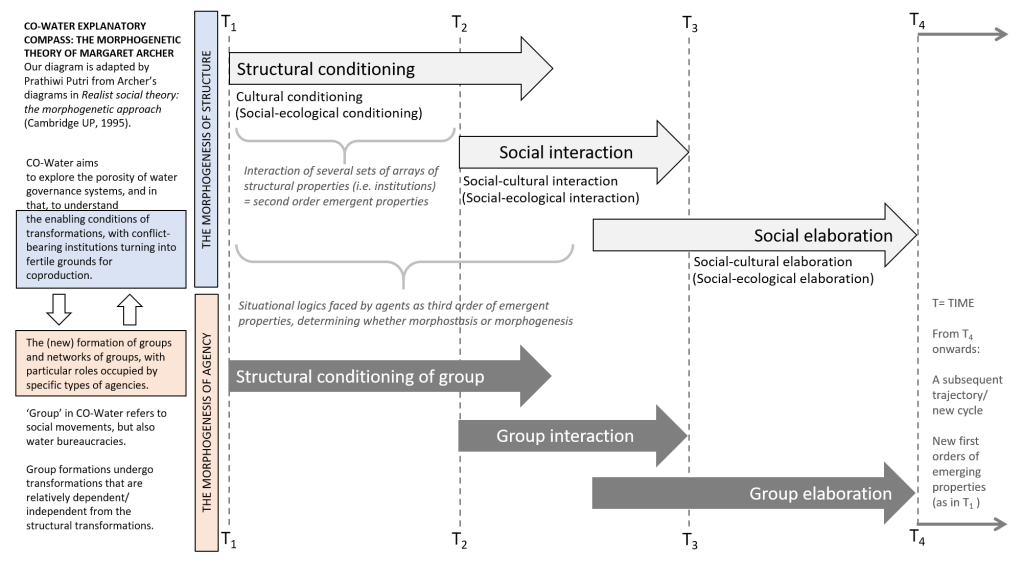
CO-Water aims to conceptualise a grassroots-led model of polycentric water governance in which the initiatives and aspirations of social movements are fruitfully integrated into co-production in the water sector. Four objectives have been defined: to comprehend the specific conflicts through which social movements come into being; to understand the potentialities and limitations of social movements in catalysing new forms of co-production; to evaluate existing state-led water governance and institutions, in regards to their transformational potentialities; and to envision a model of grassroots-led polycentric water governance by engaging with concerned groups. The empirical research consists of case studies of three social movements in the Jakarta metropolitan delta, as well as complementary case studies from Europe and Latin America. We look at the experiences of social movements in regards to these objectives, to advance key features of co-production and polycentric governance theories. Four bodies of literature are mobilised and cross-fertilised: the key works of Elinor Ostrom and selected reviews, developments, and critiques of these works by others; collective action literature within spatial planning and development studies, public administrative and management studies; literature on water governance in the Postcolonial South; and literature on urban social movements. Training during the Fellowship will focus on systematically expanding the researcher’s theoretical horizon with an advanced comprehension of theories, improving her research and teaching methodology, extending her professional networks, and learning the management aspects of scientific co-operation and research development. Fuelled by an interdisciplinary approach to environmental conflicts, the Fellowship will link her research to development practices and add value for the coherent implementation of several SDGs, particularly SDG#6 on water and sanitation and SDG#11 on cities and communities.
A video interview at Universität Kassel
A Marie Skłodowska-Curie Action Story

What is water privatisation, and what do actors actually do in pursuing that? A critical view with Gemma Gasseau – CO-Water Voice. Turning Water Conflicts into Co-productions
- What is water privatisation, and what do actors actually do in pursuing that? A critical view with Gemma Gasseau
- Marwa on the structure, institution and agency of water governance in Jakarta
- Preeta Dhar on Accountability in Water Governance
- Dona Geagea on commoning water – explaining the case of Terrassa and Naples
- THE POINT IS TO EXPLAIN IT, YES?!
 Prathiwi Putri